jump to...
When the Founder Becomes the Trust Layer
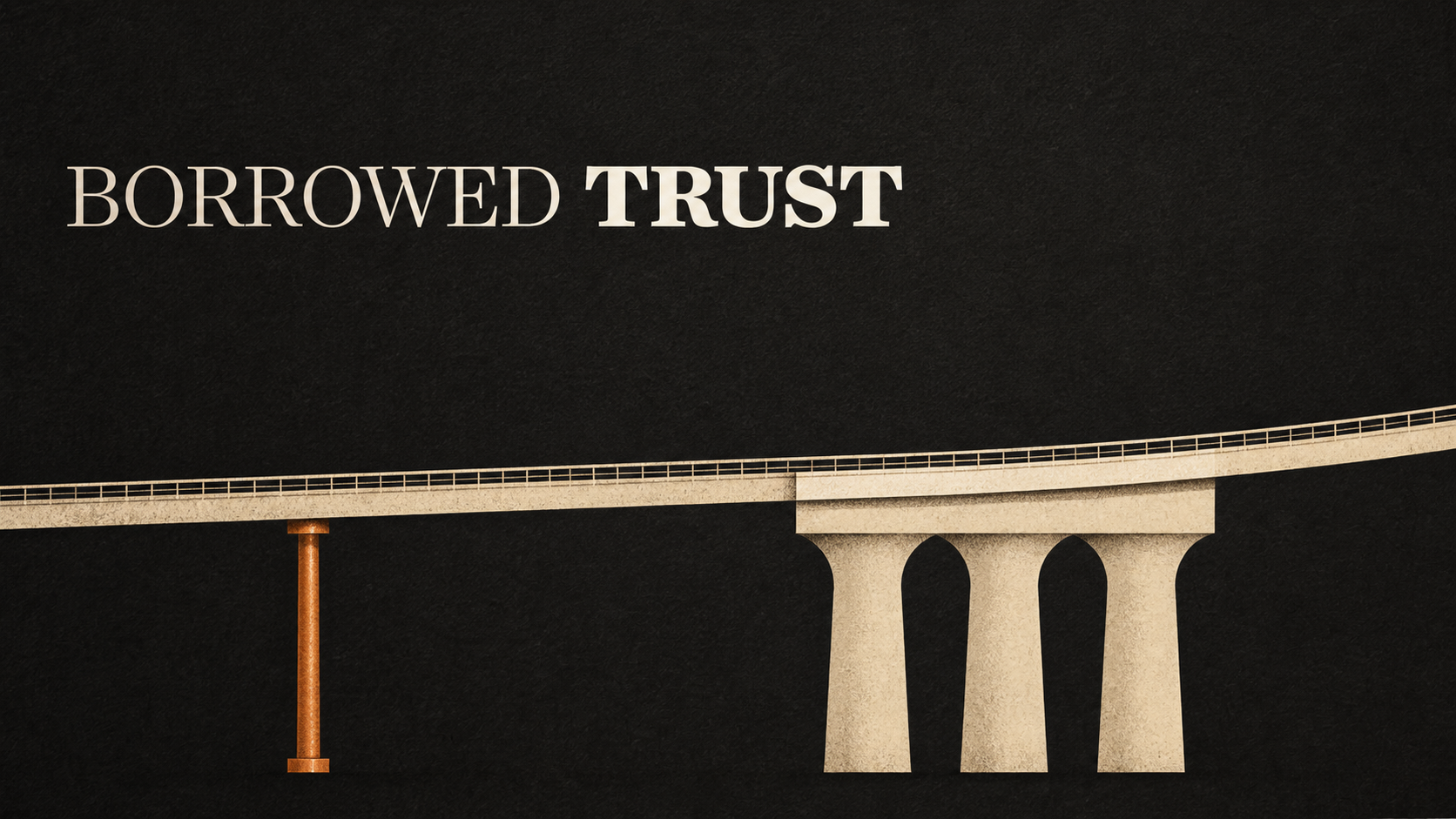
How young companies borrow credibility from their founders—and why that trust must eventually become institutional.
A startup asks customers to trust its future before it has enough past to prove itself.
That is the trust problem underneath almost every early-stage software company.
An established vendor can point to years of uptime, reference customers, audited controls, support history, a recognizable leadership team, and an organization that has already survived a few difficult cycles. A startup may have pieces of that evidence, but rarely enough of it. The product is still changing. The roadmap is partly a promise. The team is small. The company may not yet know how it will behave under every kind of pressure.
Something has to fill the gap between what the company can prove and what it is asking customers to believe.
Often, the founder does.
Trust without history
Buying software from a young company is not only a judgment about the current product. It is also a forecast.
Will the team respond when the integration breaks? Will it listen when an important use case does not fit the roadmap? Will it tell the truth about a security problem? Will it keep building through a difficult market? Will the company still be there after the buyer has reorganized work around its product?
A demo cannot answer all of those questions. Neither can a benchmark, a polished security page, or an impressive customer logo.
Those signals matter. Product quality, reliability, security, service, and customer outcomes are not optional, and in many software categories they remain genuine differentiators. Founder visibility should never be used to downgrade the importance of evidence.
It addresses a different kind of uncertainty.
Evidence helps buyers evaluate what works today. Founder visibility helps them predict what will happen when it does not work tomorrow.
Visibility, in this sense, means more than attaching a face to the homepage. It gives customers, employees, investors, and partners a record of behavior to examine. They can see how the founder explains trade-offs, handles criticism, responds to mistakes, treats customers, admits uncertainty, and changes direction when the evidence changes.
The founder becomes observable.
That observability can act as an informal behavioral warranty. The company cannot yet offer decades of institutional history, but it can offer a person whose judgment and reputation are visibly attached to what happens next.
Visibility is not verification
This model is powerful because people can evaluate people more easily than they can evaluate an unfamiliar organization. It is also dangerous for exactly the same reason.
A camera is not an audit. A large following is not a service-level agreement. A compelling origin story does not make a system secure. Charisma can make a weak operation feel trustworthy, while a private founder can build an excellent company.
Founder-led trust therefore works only as part of a larger stack:
- Product proof: Does the product work? Demos, reliability, security evidence, references, and customer outcomes belong here.
- Founder judgment: What happens when reality departs from the demo? The founder’s decisions, candor, responsiveness, and accountability belong here.
- Institutional reliability: Can the company deliver consistently without the founder personally intervening? Team depth, support systems, governance, and operating discipline belong here.
These layers complement one another. They are not substitutes.
The danger begins when familiarity with the founder starts impersonating due diligence on the company. Customers may feel that they know the person and unconsciously convert that feeling into confidence about product quality, security, or organizational durability. The founder’s visibility then stops reducing uncertainty and starts concealing it.
The healthiest founder-led companies make the distinction explicit. They allow the founder to make judgment visible while continuing to prove the product and strengthen the institution.
When the founder becomes the brand
At the beginning, the overlap between founder and company can be useful. A young organization has little identity of its own, so it borrows the founder’s reputation, language, values, and worldview.
But this changes how branding works.
A conventional branding exercise can begin with the audience: Who do we want to attract? What do they value? What identity should the company create to appeal to them?
A founder-led company faces a more constrained question:
Which true parts of who I am and how I operate are relevant to the people deciding whether to trust this company?
That is still strategy. Authenticity does not remove intentionality from branding. It moves the work from inventing a persona to selecting and emphasizing what is both true and useful.
The distinction matters because the company will inherit the founder’s strengths. It will also inherit the founder’s limitations.
A founder known for technical depth may lend technical credibility to the product. A founder who communicates clearly during a failure may make accountability part of the brand. A founder who reacts defensively to criticism may teach the market something else entirely.
Once the founder becomes publicly inseparable from the company, personal behavior becomes commercial infrastructure. A public statement can affect customer expectations, employee morale, candidate interest, investor confidence, partnerships, and eventually even the company’s ability to operate without that person.
Founder communication is no longer merely self-expression. It becomes a form of external governance: it sets expectations the company will later be judged against.
Every disclosure is a segmentation decision
Suppose a software founder repeatedly says, “We will always choose speed over process.”
That statement may attract builders who want autonomy, investors who value rapid iteration, and customers who need a vendor willing to move quickly. It may repel candidates who prefer stability and buyers in regulated environments who need disciplined change control.
That sorting may be useful. The statement reveals an operating principle that affects the relationship stakeholders are considering.
Now compare it with a strong opinion about an unrelated cultural, political, or aesthetic preference. The opinion may be completely sincere. It will still attract some people and distance others, but the sorting may tell them nothing about the founder’s competence, incentives, reliability, or service.
Of course, some founders intentionally build mission-driven companies in which social or political commitments are operationally relevant. In those cases, the sorting is part of the decision. The point is not that founders should avoid every subject outside the product. The point is that the outcome should be understood and chosen.
Every personal disclosure sorts the audience. The question is whether it sorts people along a dimension that matters.
And for a startup, “the audience” is larger than the customer base. Founder communication also sorts prospective employees, investors, advisors, partners, and acquirers. A casual post can influence who wants to work with the company long before the founder sees the effect.
Social media adds another complication. It does not transmit a person neutrally. It rewards some characteristics more than others, often favoring certainty, conflict, novelty, and provocation. One authentic part of a founder can become the only part the market sees. Eventually, the person may feel pressure to keep performing the version of themselves that the algorithm rewarded.
That is another reason unfiltered communication is not the same thing as authenticity.
Authenticity is not total disclosure
Founders are often presented with a false choice: hide behind a polished corporate persona or publish their entire personality in the name of authenticity.
Neither is necessary.
Authenticity is the absence of contradiction between the identity a founder presents and the person making the decisions. It does not require making every belief, preference, relationship, or private detail available for public evaluation.
Privacy can be authentic. Restraint can be authentic. Recognizing that a complex belief cannot be carried responsibly by a short post can be authentic.
Every public identity is edited because every communication channel is limited. The ethical problem is not incompleteness. It begins when selection creates a materially false impression, conceals something stakeholders genuinely need to evaluate, or repeatedly contradicts the founder’s actual behavior.
Intentionality, then, is not the enemy of authenticity. It is part of responsible leadership.
Before publishing something personal, a founder can ask:
- Is it true?
- Is it relevant to how stakeholders should evaluate my judgment, incentives, competence, or accountability?
- Can this medium carry enough context for the message to remain honest?
- Am I comfortable attracting and repelling people on this particular dimension?
- Does this strengthen trust in how the company operates, or does it merely increase attention around me?
If the first answer is yes and the others are no, choosing not to publish is not dishonesty. It may be good editorial judgment.
Borrowed trust has a maturity date
The founder’s reputation is bridge financing for trust.
It can help a young company cross the gap between an unproven institution and a consequential customer commitment. But bridge financing is not permanent capital. Over time, the organization has to replace personal assurances with evidence and systems of its own.
Founder responsiveness should become a support standard. Personal product judgment should become principles and decision processes that the team can apply. Technical credibility should spread across visible experts, architecture, documentation, and review practices. Promises made in public should become contracts, service levels, postmortems, and repeatable operating behavior.
Customers should gradually become able to trust the company without needing direct access to the founder.
If that transfer never happens, the original advantage becomes a constraint. Every escalation flows to one person. The team struggles to earn authority in the market. Customers interpret founder attention as the normal service model. Succession becomes difficult. An acquisition becomes harder because too much of the company’s value walks out with the founder.
For an enterprise buyer, access to the founder can feel reassuring during an early sale. Continued dependence on the founder eventually signals that the organization itself may not be ready.
The founder should bootstrap trust, not permanently monopolize it.
The real job of a visible founder
The strongest visible founders are not simply charismatic. They make their judgment observable, their commitments testable, and their organizations progressively less dependent on personal intervention.
They show enough of themselves for people to understand what they stand behind. They exercise enough restraint to keep the company from becoming an unfiltered extension of one personality. Most importantly, they translate personal credibility into organizational capability.
At the beginning, customers ask, “Do I trust this person?”
As the company matures, the more important question becomes, “Has this person built something trustworthy beyond themselves?”
A founder can lend a young company credibility. The company eventually has to repay the loan by becoming credible on its own.
The founder may be the first trust system. They should not remain the only one.
Daron Yondem advises senior technology leaders on AI-driven organizational transformation. Learn more →