The Most Underrated Career Move in AI? Studying Humans
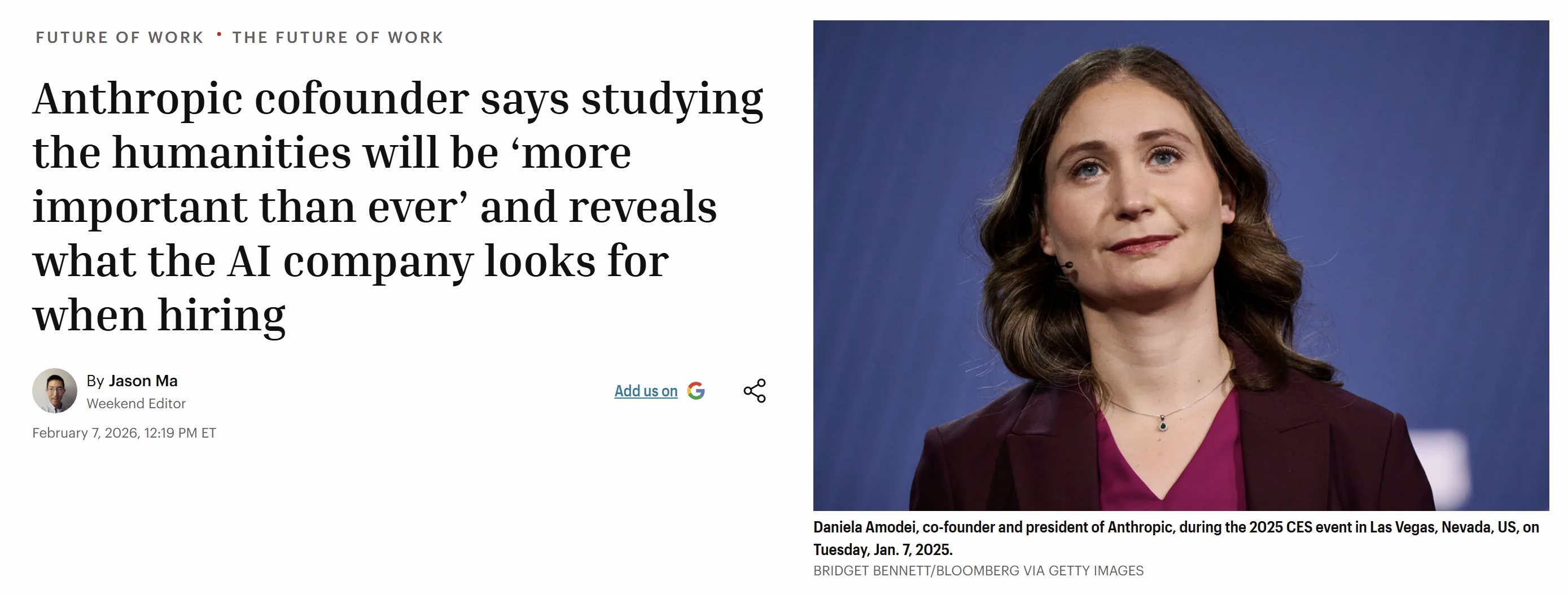
Anthropic’s co-founder Daniela Amodei told Fortune this week that studying the humanities will be “more important than ever” in the age of AI. She said the models are already very good at STEM, and that critical thinking, understanding history, and knowing how to interact with people will matter more in the future, not less.
When I read that, my first reaction wasn’t surprise. It was relief. Relief that someone running one of the most consequential AI companies on the planet is saying out loud what I’ve been building my entire career around, quietly, sometimes awkwardly, often against the grain.
Because here’s the thing nobody tells you when you’re deep in the STEM pipeline: technical skills get you hired. Human skills get you influence.
My Credentials Should Have Made Me a Pure Technologist
On paper, I look like someone who went all-in on STEM. BS in Information Technology. MS in Computer Science. MEng in Engineering Management. I was a CTO at two startups. I led application innovation at Microsoft. I’m currently at AWS working on AI/ML strategy and architecture.
If you stopped reading there, you’d file me under “senior technical leader” and move on.
But here’s what actually differentiates me, and I say this with the benefit of hindsight, having lived both tracks, it’s the other stuff.
An MA in Organizational Leadership. A PhD studying how community engagement and technical blogging shape leadership perception in software engineering organizations. An NBC-HWC health and wellness coaching certification. A Master of Education in Adult Teaching and Training that I’m pursuing right now, in 2026, while working full-time in AI.
Why would a cloud AI strategist study adult education? Because I’ve watched brilliant technologists fail to move organizations. Not because their architecture was wrong, but because they didn’t understand how adults learn, resist, adopt, and change. That’s not a technical problem. That’s a human one.
The Wall I Kept Hitting
Early in my career, I assumed that if the technology was right, people would follow. Build it correctly, present it logically, and the organization will adopt it.
That assumption is wrong. It’s spectacularly, consistently, painfully wrong.
I’ve presented at conferences in 13+ countries, work with teams across 109+ countries. Hundreds of talks. Thousands of conversations with technology leaders across every industry and culture you can imagine. And the pattern I kept seeing was the same everywhere: the technical solution was rarely the bottleneck. The bottleneck was always human, communication breakdowns, cultural resistance, misaligned incentives, leaders who couldn’t translate vision into something their teams could feel.
This isn’t a soft observation. My doctoral research confirmed it empirically. When I studied software engineering teams, the leaders who built community, who engaged through writing and events and genuine human connection, were perceived as more effective. Not because they were better coders. Because they were better humans in the context of their organizations.
Coaching Taught Me More Than Any Architecture Certification
A few years ago, I went through the process of becoming a certified health and wellness coach, the real kind, board-certified through the National Board for Health & Wellness Coaching. People in tech found this baffling. Why would someone working on cloud AI strategy at a major tech company spend time learning motivational interviewing and behavioral change theory?
Because coaching is the applied science of understanding why people do what they do and helping them do something different. That’s the most transferable skill in the world right now.
When I coach entrepreneurs and technology professionals today, I’m not giving them technical advice. I’m helping them navigate ambiguity, reframe problems, and make decisions in complex systems where the “right answer” depends entirely on context. That’s exactly what organizations need as they figure out how to work alongside AI.
Daniela Amodei said Anthropic hires for “excellent EQ and people skills, who are kind and compassionate and curious and want to help other people.” That’s literally a coaching competency framework. She described a coach, not an engineer.
The Combination Is the Moat
I want to be clear: I’m not making an anti-STEM argument. That would be absurd, especially coming from someone who works in AI infrastructure daily. The technical foundation matters. You can’t think critically about AI transformation if you don’t understand what the technology actually does.
But the technical foundation alone is rapidly depreciating as a differentiator. The models are getting better at code every quarter. They’re getting better at analysis, at synthesis, at pattern matching. They’re not getting better at understanding why a 200-person engineering team across three continents resists a perfectly logical reorganization, or why a CEO’s stated strategy and actual behavior are pointing in opposite directions.
What’s rare and what I think becomes the real career moat is the combination. People who can build the system AND understand the humans who have to live inside it. People who can read a technical architecture diagram and an organizational culture with equal fluency.
I’m writing a book right now about how AI transforms teams, culture, and work at the organizational level. The framework I’ve developed isn’t technical. It’s built on Culture, Communication, and Delegation, three fundamentally human dimensions. But it only works because I’ve spent decades on the technical side too. You need both lenses to see the full picture.
What This Means If You’re Building Your Career
If you’re early in your career and wondering whether to double down on technical skills or invest in “softer” things like leadership, communication, psychology, coaching, teaching, or organizational behavior, let me save you some time.
Do both. But don’t treat the human skills as optional electives. Treat them as core infrastructure.
Here’s why: AI is making technical execution cheaper every day. What it’s not making cheaper is judgment. The ability to sit in a room with six stakeholders who all want different things and find the path forward. The ability to coach a struggling team lead through a transition without a script. The ability to teach complex concepts to adults who are scared that AI is about to replace them.
These aren’t soft skills. I really wish we’d stop calling them that. They’re the hard skills that most technical people never develop because they assume the technology should speak for itself.
It doesn’t. It never has. And as AI gets more powerful, the gap between “technically correct” and “organizationally effective” is only going to widen.
The Quiet Vindication
When Daniela Amodei, literature major, co-founder of the company that builds Claude, says the humanities matter more than ever, it’s not a contrarian hot take. It’s pattern recognition from someone sitting at the center of the AI revolution.
And when I look at my own winding path from solution architecture to organizational leadership to coaching certification to adult education to writing about how AI transforms human collaboration, I don’t see a scattered career anymore. I see someone who was, maybe without fully realizing it, preparing for exactly this moment.
The models will keep getting better at STEM. The question that matters now is different: Do you understand the humans who have to work alongside them?
That’s the durable skill. That’s the one worth investing in.
If you enjoyed this, subscribe to my newsletter for more on the intersection of AI, leadership, and the human side of technology.
Daron Yondem advises senior technology leaders on AI-driven organizational transformation. Learn more →