The C-Suite Wash; When Everyone Becomes a Chief, What Does Chief Even Mean?

A colleague tagged me in a LinkedIn comment recently, drawing my attention to a post by Gary Hamel. The question he posed: “When did every SVP become a CxO, and what does this say about our organizations?”
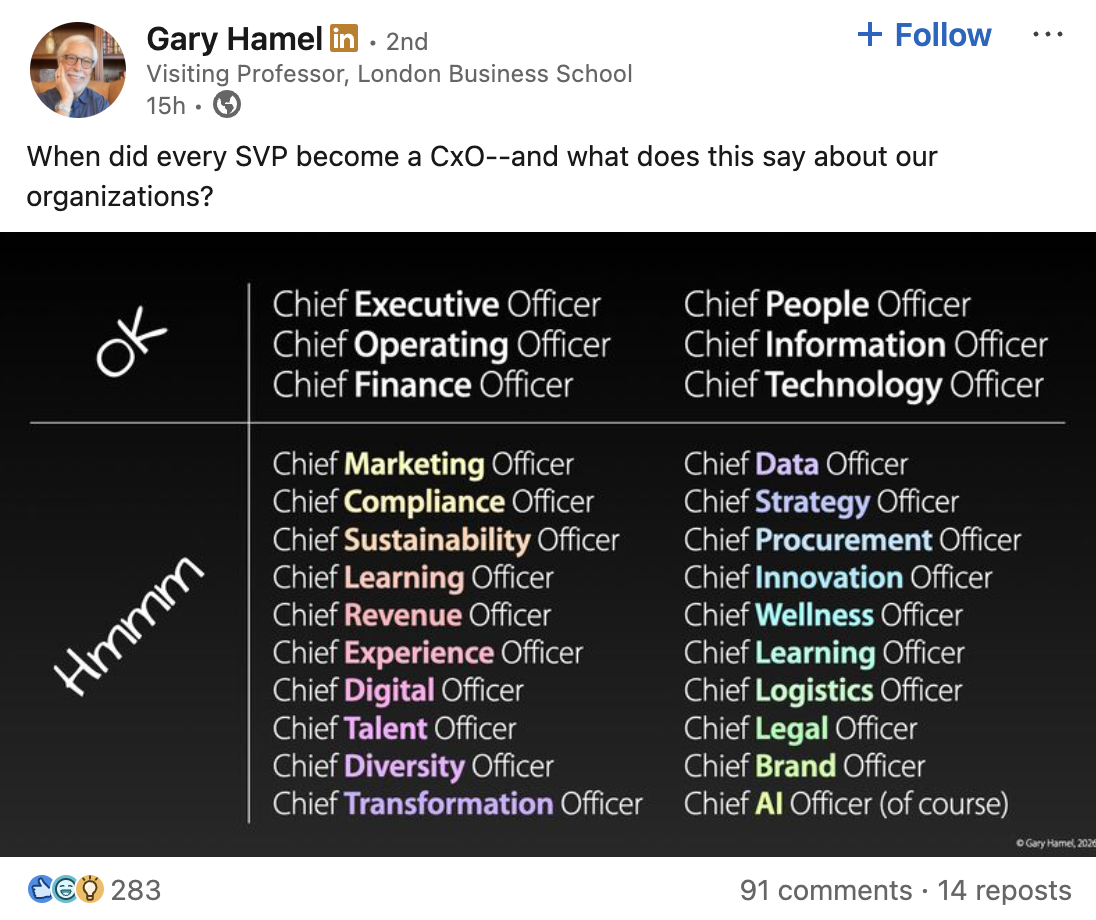
His visual was simple but damning. A list of traditional C-suite roles marked “OK.” Below it, a sprawling inventory of newer additions, Chief Wellness Officer, Chief Transformation Officer, Chief Brand Officer, marked “Hmmm.”
It’s the kind of observation that prompts defensive reactions. I’ve seen it in the comments: “Titles don’t really matter, ownership does.” The argument goes that if each role truly owns something end-to-end with clear scope and decision rights, things move faster. Title inflation is a naming issue, not an organizational design problem.
I disagree. And I think that perspective misses something fundamental about how organizations actually function.
If Titles Don’t Matter, Why Is Everyone Chasing Them?
Here’s a question: If titles were truly meaningless, why would intelligent professionals, people who optimize everything else in their careers, spend so much energy pursuing them?
The answer is obvious. Titles matter. They matter for compensation benchmarking. They matter for external credibility. They matter for access, who gets invited to which meetings, who sits at which tables, who speaks with whom. They matter for the kind of opportunities that flow to you versus past you. A Director sends one signal to the market. A Chief sends another.
There’s also a career mobility dimension that operates at every level, not just the C-suite. When HR professionals and recruiters search for candidates, the first instinct is title matching. Looking for a Director? Search for people who’ve been Directors. Need a VP of Engineering? Filter for VP of Engineering. If “Director” never appears in your career history, it looks like you never handled that scope, even if you functionally did the work under a different title. The algorithm, whether human or automated, doesn’t see your actual responsibilities. It sees the label.
This creates a rational incentive to pursue titles not for vanity, but for optionality. People hold onto titles because their next opportunity will be benchmarked against them. A startup CTO who moves to an enterprise might accept a step down to Senior Director, but they’ll fight to keep “Director” in the title rather than “Manager”, not because of ego, but because of what that title unlocks for the opportunity after that.
Again, organizational size and context matter enormously here. The scope behind a title varies wildly. But the recruiting market often flattens that nuance into simple pattern matching. This is another structural pressure driving title inflation: people aren’t just chasing status, they’re protecting their future career surface area.
The “titles don’t matter” argument is a luxury available only to those who already have the titles. For everyone navigating organizational politics, career trajectories, and market positioning, the label on the business card carries weight.
But here’s where it gets complicated: the people arguing that titles don’t matter aren’t entirely wrong. They’re just solving the wrong problem.
The Internal-External Title Split
In my experience working across organizations of vastly different scales, from two-person startups to hundred-thousand-person enterprises, I’ve observed a pattern that Hamel’s list doesn’t capture: the growing gap between internal and external titles.
Many organizations maintain relatively clear internal title structures. There’s a Director of Engineering, a VP of Sales, a Head of Product. The org chart makes sense. Reporting lines are clear. Accountability is defined.
But externally? That same Director of Engineering becomes “CTO” on LinkedIn. That VP of Sales introduces themselves as “Chief Revenue Officer” at conferences. That Head of Product’s business card reads “Chief Product Officer.”
Sometimes this is explicitly sanctioned, a “business title” distinct from the “HR title.” Sometimes it’s implicit, a wink-and-nod understanding that external positioning requires different language than internal administration.
This isn’t necessarily dysfunction. It’s adaptation.
The Perception Management Problem
Consider the reality of international business relationships. A technology company headquartered in the US has operations across dozens of countries. In each market, local enterprises, the customers, partners, and prospects—have their own C-suites. The CEO of a major retail chain in Germany expects to meet with someone of equivalent standing from their strategic vendors.
But the actual global CTO of that US technology company isn’t flying to every regional customer meeting. The person who handles that relationship is probably a Regional Director or Country Manager. From a scope and accountability perspective, that Regional Director might be a perfect match for the German CEO, both are responsible for strategic direction within their domain, both make significant decisions, both carry meaningful P&L responsibility.
But there’s a title mismatch. And in cultures where hierarchy and title carry significant weight (which is most cultures, to varying degrees), that mismatch creates friction.
The solution? The Regional Director becomes the “Regional CTO” or “CTO, EMEA.” The Country Manager becomes “CEO, Germany.”
I saw this firsthand at Microsoft. In the sales organization, local sales leaders would introduce themselves as CEOs, COOs, or sometimes CTOs, titles that had nothing to do with their internal HR designation. They weren’t being dishonest; they were adapting to context. When you’re meeting with the CEO of a major enterprise customer, introducing yourself as “District Sales Manager” creates an immediate asymmetry that can undermine the relationship before it starts. So the District Sales Manager becomes the “CEO, EMEA” or “Regional General Manager” in external contexts.
This isn’t vanity. It’s perception management. And perception management is a legitimate organizational function, until it isn’t.
When Perception Management Becomes Title Wash
The problem emerges when external title inflation feeds back into internal expectations. When the “Regional CTO” starts expecting the internal authority, compensation, and political capital that global CTOs command. When the proliferation of Chiefs creates actual confusion about decision rights. When the title becomes the territory, not just the map.
I wrote recently about what I called “Leadership Wash”, the organizational tendency to relabel management teams as “leadership teams” without changing anything about what those teams actually do. The language of leadership becomes a status marker disconnected from leadership behavior.
C-Suite Wash is the same phenomenon applied to titles. Organizations create new Chief positions not because they’ve elevated a function to genuine executive accountability, but because they need the title for external positioning, or because they’re trying to retain a senior person without promoting them above someone else, or because everyone else in the industry has a Chief Whatever Officer and not having one looks like you don’t take that function seriously.
The inflation is real. The scope behind the inflation often isn’t.
The Scope Relativity Problem
Here’s an uncomfortable truth that title inflation obscures: the word “Chief” carries radically different weight depending on organizational context.
The CTO of a five-person startup has a title equivalent to the CTO of Microsoft. But the scope, complexity, and impact of those roles share almost nothing but the letters. The startup CTO might be doing hands-on coding, managing AWS bills, and making technology decisions with minimal organizational coordination required. The enterprise CTO is navigating a matrix of business units, balancing multi-year platform investments, managing thousands of engineers through layers of management, and operating in a regulatory and political environment the startup CTO has never encountered.
I’ve lived this from the startup side. As CTO of early-stage companies, my function looked nothing like what enterprise CTOs do. The title was the same; the job was entirely different. And this applies across the C-suite—CEOs, CMOs, CFOs all face the same scope relativity.
Neither role is more legitimate than the other. But calling them the same thing obscures more than it reveals.
Yet here’s where it gets interesting: this scope difference doesn’t stop organizations from using equivalent titles when they interact. In fact, it demands it.
Consider a 50-person startup selling to a 10,000-person enterprise customer (I have been there). The startup has a marketing manager, she’s the top decision-maker for marketing, owns the function end-to-end, but the internal title reflects the organizational scale. The enterprise customer has a Chief Marketing Officer with a team of hundreds.
Who talks to whom?
You’re not going to have your marketing manager meet with the customer’s CMO and accept the implicit hierarchy that title mismatch creates. What happens instead: the marketing manager becomes “CMO” in external contexts. She talks to their CMO. Peer-to-peer. Same level. Everyone in the room knows the organizations are different sizes, and that knowledge creates its own weight on how titles are interpreted. But the practice is to match titles anyway, because the alternative, accepting a subordinate position in the conversation, undermines the relationship before it starts.
This is the bidirectional nature of title inflation. Large enterprises create regional Chiefs to match local customer executives. Small companies elevate internal titles to match enterprise counterparts. The underlying dynamic is the same: titles are being used as coordination mechanisms for inter-organizational relationships, not just descriptions of internal roles.
This scope relativity creates real problems when context shifts. When a startup CTO moves to an enterprise and expects to remain a CTO, there’s a mismatch. When an enterprise executive evaluates a candidate based on their “CTO experience” without understanding the organizational context, they’re comparing incomparable things.
The title has become decoupled from the scope.
The Psychology of Chief-ness
Beyond the practical perception management dynamics, there’s a psychological dimension worth acknowledging. “Chief” carries symbolic weight that other titles don’t. It implies ultimate accountability. Final authority. Strategic vision. Sitting at the executive table.
There’s nothing wrong with aspiring to those things. But the aspiration to the title and the aspiration to the substance are different and title inflation lets people pursue the former while avoiding the harder work of the latter.
In Leadership Wash, I argued that genuine leadership is measured by the leaders you create, not the followers you accumulate. A similar principle applies here: genuine executive impact is measured by the decisions you own and the outcomes you drive, not by the impressiveness of your title.
When organizations hand out Chief titles liberally, they’re not elevating functions, they’re diluting the meaning of elevation.
What This Says About Our Organizations
Hamel asked what the proliferation of CxO titles says about our organizations. Here’s my read:
It says we’ve developed a dependency on positional markers as substitutes for substantive clarity. When everyone is a Chief, the title no longer carries information about actual decision authority, scope, or accountability. It becomes noise rather than signal.
It says we’ve created organizational structures where external perception management has become more sophisticated than internal role clarity. We can navigate the subtle signals of customer relationships and market positioning with nuance, but we struggle to answer basic questions about who actually decides what.
It says we’ve allowed title inflation to become a tool for individual career management rather than organizational design. People accumulate titles like credentials, and organizations accommodate that accumulation rather than maintaining coherent structures.
And it says we’ve conflated visibility with accountability. The proliferation of Chief positions often reflects which functions have the best PR within the organization, which leaders have successfully argued that their domain deserves “a seat at the table”, rather than which functions genuinely require executive-level integration.
A More Useful Framework
Rather than asking whether an organization has “too many Chiefs,” I’d suggest asking different questions:
For internal clarity: Can every person in the organization answer these questions: Who makes decisions about X? Who is accountable when X fails? Who needs to be consulted versus informed? If the answers require referencing three different org charts, the internal structure, the external titles, and the “real” political structure, you have a design problem that titles can’t solve.
For external positioning: Is the gap between internal and external titles acknowledged and managed intentionally? Or has it grown organically without anyone thinking through the implications? A deliberate “business title” strategy is legitimate. A sprawling inconsistency where everyone crafts their own external identity creates confusion and erodes trust.
For individual accountability: Does this person make decisions commensurate with the title they carry? A Chief officer should own something meaningful end-to-end. They should be accountable for outcomes, not just activities. They should have genuine authority, not just responsibility. If the “Chief” is actually executing someone else’s strategy rather than setting direction, the title is decorative rather than structural.
For organizational honesty: Are titles being used to solve structural problems or avoid them? Promoting someone to Chief because you can’t figure out how to retain them otherwise is using titles as compensation substitutes. Creating a Chief Whatever Officer because you’re embarrassed not to have one when competitors do is using titles as positioning proxies. Neither is inherently wrong, but both should be acknowledged for what they are.
The Uncomfortable Conclusion
Title inflation isn’t going to reverse. The external pressures that drive it, market expectations, customer perception management, international business dynamics, individual career optimization, are structural, not cultural. No organization is going to unilaterally deflate their titles and put themselves at a perceived disadvantage.
But organizations can choose to be honest about what titles represent. They can maintain internal clarity even when external positioning requires flexibility. They can treat the proliferation of Chiefs as a signal that deserves attention rather than a norm to be accepted.
And individuals can choose to focus on substance over symbols. The question isn’t whether you have a Chief title, it’s whether your decisions, your accountability, and your impact warrant one.
In Leadership Wash, I concluded that “leadership isn’t a title you receive. It isn’t a personal brand you cultivate. It’s a transformation you facilitate.” The same applies here. Executive authority isn’t a title you negotiate. It isn’t a business card you design. It’s a scope you actually own and outcomes you actually drive.
When everyone is a Chief, being a Chief means nothing. When your decisions and accountability justify the title, it means everything, regardless of what your business card says.
Daron Yondem advises senior technology leaders on AI-driven organizational transformation. Learn more →